Bed bugs after travel: how to check your luggage
Updated .
Hotels, holiday visits, flights, buses and student residences are some of the most common ways bed bugs reach Ottawa homes, and they arrive hidden in suitcases, bags and clothes. Whether you just got back from a trip or you are packing for the holidays, this guide shows how to check your luggage when you get home, how to check a hotel room before you unpack, and what to do if you think something came home with you.
How do I check my luggage for bed bugs after travel?
Check your luggage for bed bugs before it comes into your bedroom: open it on a hard, light-coloured floor away from beds and couches, look along every seam, zipper and pocket with a flashlight, put all clothes straight into the washer and dryer, and vacuum the empty suitcase. Then store it away from where you sleep.
Bed bugs do not fly or jump. They crawl into the folds of a bag or a piece of clothing during the night and stay hidden until they are carried somewhere new. That is why the first hour after you get home matters most: what you do with your bags decides whether a hitchhiker stays in the suitcase or ends up in your bed.
How do bed bugs get into luggage when you travel?
Bed bugs get into luggage when a bag sits on or near a bed, couch or carpet in a place that has them, and the bugs crawl into seams, pockets and folded clothes looking for a dark place to hide. They are not a sign of a dirty hotel or a dirty traveller. They go wherever people sleep.
- Hotel and motel rooms, including good hotels. A suitcase left open on the bed or a soft chair is the classic route.
- Staying with family or friends over the holidays, especially sleeping on a pull-out couch or in a guest room that others use often.
- Student residences and shared housing. Students coming home to Ottawa for winter break or the summer bring their whole room with them in a few bags.
- Short-term rentals, cottages and hostels, where many guests come and go.
- Buses, trains and planes. Less common, but bags stored next to other people's belongings can pick up a bug.
Where do bed bugs hide in a suitcase?
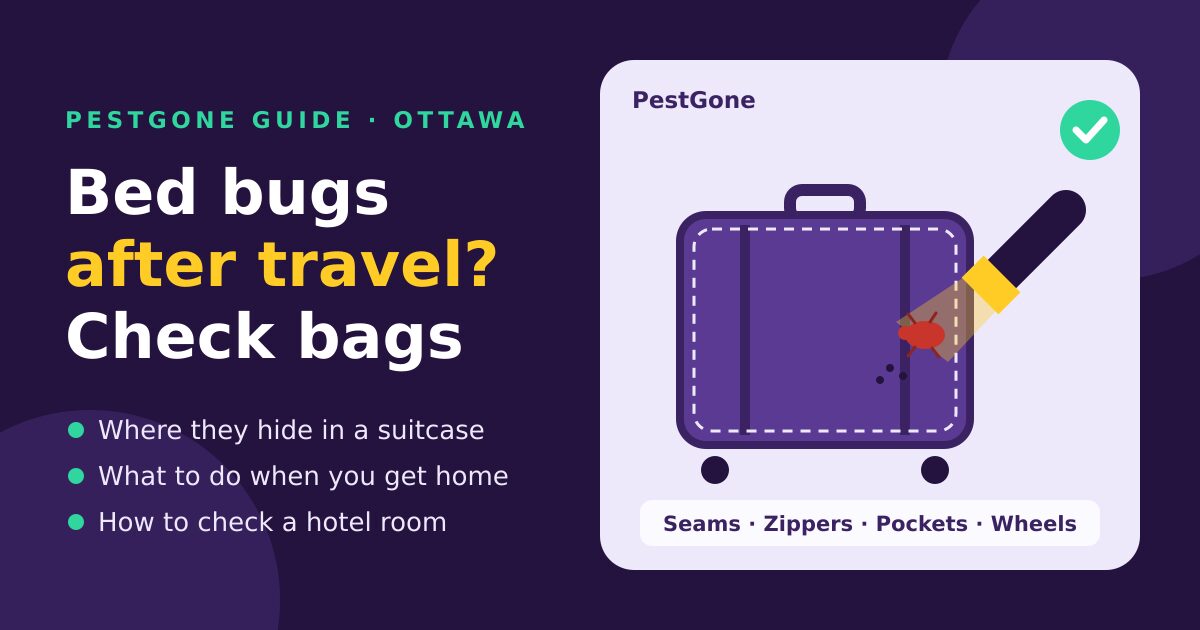
Bed bugs hide in the tightest folds of a suitcase: the zipper tracks, piping and seams around the edges, inside pockets and the lining, and under the wheels, handle and feet. Soft fabric bags have far more of these hiding spots than hard-shell cases. Look closely at:
- The zipper tracks and the fabric flaps that cover them, inside and out.
- The piping and stitched seams along every edge.
- Inside every pocket, including the mesh pockets in the lid.
- Under the lining at the corners, where it is stapled or stitched to the frame.
- Around the wheel housings, telescoping handle, carry handles and the small feet on the bottom.
- Backpacks, purses, laptop bags, shoe bags and toiletry bags, which often get forgotten.
What you are looking for: live bugs (flat, oval and reddish-brown, about the size of an apple seed), tiny pale eggs, papery shed skins, and small dark spots like dots from a felt-tip marker. Our guide to the signs of bed bugs shows what each one looks like.
What should I do with my luggage when I get home from a trip?
When you get home, unpack straight into the laundry, check the empty bag on a hard floor, then vacuum it and store it away from bedrooms. Health Canada advises checking luggage on a hard surface before it comes further into the home. Step by step:
- Stop at the door. Leave suitcases on a hard floor in the front hall, a tiled bathroom, the laundry room or the garage. Do not put them on the bed, couch or carpet.
- Unpack straight into the wash. Take clothes out one piece at a time and put them directly into the washer, or into a sealed plastic bag if you cannot wash them right away.
- Wash in hot water, then dry on high heat. Health Canada advises washing all clothes and fabric items in hot water, worn or not, and drying items that cannot be washed on the highest dryer heat for 30 minutes. Ottawa Public Health gives the same 30-minute hot-dryer advice. Check care labels first.
- Check small items such as toiletry bags, hairbrushes, shoes, chargers and books before putting them away.
- Inspect the empty suitcase with a flashlight, using the list above.
- Vacuum the suitcase inside and out, especially seams, pockets and zippers. Then put the vacuum bag, or the contents of a bagless canister, into a sealed garbage bag and take it straight outside.
- Store luggage away from bedrooms, ideally in a closet or storage room with a hard floor, not under the bed.
Does the dryer kill bed bugs in clothes?
Yes. A clothes dryer on high heat for at least 30 minutes kills bed bugs and their eggs in clothes and fabric items, which is why both Health Canada and Ottawa Public Health recommend it. The heat is what does the work: washing alone, especially in cold water, is not enough.
For delicate items that cannot go in the dryer, keep them sealed in a plastic bag and ask your technician what to do with them if bed bugs are later found. Dry cleaning is another option for some items; tell the cleaner they may have bed bugs.
Will leaving my suitcase in the garage or a cold car kill bed bugs?
Do not count on it. Leaving a suitcase in an Ottawa garage or car in winter is not a reliable way to kill bed bugs, because you cannot control how cold it gets or for how long, and garages warm up during the day. Bed bugs can also survive for months without feeding, so simply leaving luggage unused does not starve them out quickly.
Keeping luggage in the garage is still a sensible place to check and store it, away from beds. Just treat it as storage, not as treatment: check, vacuum and launder as described above.
How do I check a hotel room for bed bugs?
Check a hotel room for bed bugs before you unpack: put your bags in the bathroom on the tile floor, then use your phone's flashlight to look at the mattress corners, the headboard, the luggage rack and the furniture closest to the bed. It takes about five minutes. Health Canada's travel advice suggests checking:
- The mattress and box spring: lift each corner of the sheets and look along the seams, piping and tufts.
- Behind the headboard and the wall behind the bed, where bugs often gather. Many hotel headboards are fixed to the wall, so shine your light into the gap.
- Pillows, bedding and the bed skirt.
- The bed frame and legs.
- The luggage rack, especially where the straps attach to the metal bars.
- The closet, its cracks and corners, and any upholstered chair or couch.
While you stay, keep your suitcase on the checked luggage rack or a hard floor, keep it closed when you are not using it, and do not unpack into the dresser drawers or store anything under the bed. Health Canada also suggests packing a few large, light-coloured plastic bags to keep your belongings separate on the road, and not bringing your own pillow.
What should I do if I find bed bugs in a hotel?
If you find bed bugs in a hotel, tell the front desk right away and ask for another room that is not next to, above or below the first one, or stay somewhere else. Take clear photos of what you found. Then treat everything you brought into that room as possibly carrying bugs.
- Move your luggage onto a hard surface, away from the bed, before you do anything else.
- Check your bags and clothes before moving them to a new room.
- Seal clothes in plastic bags until you can wash and dry them on high heat.
- When you get home, follow the luggage steps above in full, and keep a closer eye on your bed for the next few weeks.
Woke up with itchy marks after a night away? Bites on their own do not prove bed bugs, because mosquitoes, fleas and skin conditions look alike and many people do not react to bed bug bites at all. Our guide on bed bug bites vs mosquito and flea bites explains the difference. If bites are very itchy, swollen or look infected, speak to a pharmacist or doctor.
How do I know if I brought bed bugs home from a trip?
You know you brought bed bugs home if you start finding the signs in your own home after the trip: small dark spots on mattress seams or sheets, tiny rust-coloured smears, shed skins, or live bugs around the bed. Bites alone are not enough to be sure. A few hitchhikers can take weeks to show up, so check your bed for a while after you get back.
Check where they usually settle first: the seams and corners of the mattress and box spring, the bed frame and headboard, and the couch if someone in the home naps on it. Our guide to bed bugs in your couch covers how to check a sofa or recliner. A simple habit helps for the first few weeks after a trip: look along the mattress seams with a flashlight each time you change the sheets.
What should I do if I think I brought bed bugs home?
If you think you brought bed bugs home, keep sleeping in your own bed, wash and hot-dry the bedding and the clothes from the trip, seal the clean items in bags, and book an inspection. Do not throw out your mattress or start spraying. Early, small problems are the easiest to treat.
- Keep sleeping in your bed. Moving to the couch or a guest room usually spreads the bugs to a second room.
- Do not use bug bombs or foggers. They do not reach bugs hidden in cracks and can scatter them.
- Do not throw out your mattress or furniture yet. Most items can be treated, and our guide on how long bed bug treatment takes covers the keep-or-throw question.
- Keep the travel luggage stored away from bedrooms until your technician has seen it.
- If you rent, tell your landlord or property manager in writing. In Ottawa, landlords are generally responsible for pest treatment, and tenants for preparing the unit. See our guide to bed bugs in an apartment.
Bed bugs and holiday travel in Ottawa
December and early January are busy travel months in Ottawa: trips south, family visits across Ontario and Quebec, and students coming home from residence for winter break. That makes the weeks after the holidays a good time to check luggage and beds carefully, especially if you hosted guests on a pull-out couch or in a spare room.
We treat bed bugs in every kind of Ottawa home, from condos in Westboro and apartments in Centrepointe and Bayshore in Nepean to houses in Stonebridge in Barrhaven and Avalon in Orléans. A discreet visit is available on request, which many people ask for after a trip.
Quick answers about bed bugs after travel
Can bed bugs live in a suitcase?
Yes, for a while. They hide in seams, zippers, pockets and the lining, and can survive for months without feeding, so check and vacuum luggage after every trip.
Are hard-shell suitcases better than fabric ones?
They are easier to check, because they have fewer seams and folds, and light colours make bugs easier to see. Health Canada suggests light-coloured plastic luggage.
Should I unpack in the bathroom or garage?
Unpacking on a hard floor away from beds and couches, such as a bathroom, laundry room or garage, makes it easier to spot bugs and keeps them out of bedrooms.
Do I need to wash clothes I did not wear?
Yes. Health Canada advises washing all clothing and fabric items from the trip, worn or not, because bugs can hide in anything that was in the room.
Can I spray my suitcase with something?
We do not recommend it. Vacuuming, hot washing and hot drying are the safest steps at home. If bed bugs are confirmed, your technician treats what needs it.
How much does bed bug treatment cost in Ottawa?
Our bed bug treatment is one flat price of $399 plus HST for your home, including the follow-up treatment about two weeks later and a six-month guarantee: if bed bugs return, we re-treat for free. Whole buildings are quoted separately. You can compare every service on our pricing page.
Book bed bug treatment online
If you found signs after a trip, pick a day and time window on our booking page and we will email you to confirm. Our Ottawa bed bug treatment includes an inspection to confirm bed bugs before treating, steam and spray treatment of beds, frames, headboards, furniture, baseboards and cracks, a step-by-step preparation guide before the visit, a follow-up treatment about two weeks later, advice on mattress and box-spring encasements, a discreet visit on request, and a six-month guarantee: if bed bugs return, we re-treat for free. Our bed bug preparation checklist shows what the preparation involves.
Have a question first? Read our pest control FAQ or contact us.
Book online See bed bug treatment ($399 + HST)
Not sure what you're dealing with? Call 343-341-2815 and describe it. We'll tell you what it is and what it costs.
Keep reading
- Signs of bed bugs, and what to do first
- Bed bug bites vs mosquito bites (and flea bites): how to tell
Sources
- Bedbugs: how do I avoid them when travelling?, Health Canada
- Bedbugs: how do I prevent an infestation?, Health Canada
- Bed bugs, Ottawa Public Health
General information for homeowners. Every home is different; your technician will confirm what applies to yours.
Let's make them gone.