Bed bugs in your couch: how to check and what to do
Updated .
Bed bugs are named for beds, but they live wherever people sit or lie still for long stretches, and the couch is the next most common place to find them. If you keep getting bites after evenings on the sofa, or you found dark spots along a cushion seam, this guide shows you where to look, how to check properly, what to do tonight, and whether the couch can be saved.
Can bed bugs live in a couch?
Yes. Bed bugs can live in a couch, sofa, recliner or upholstered chair, hiding in seams, cushion zippers, tufts and the wooden frame. They go wherever people rest for long periods, so a couch someone naps or sleeps on is a common hiding place. A couch with bed bugs can usually be treated rather than thrown out.
Bed bugs do not need a mattress. They need a person nearby for a blood meal and a tight, dark crack to hide in between meals. A couch offers plenty of both, especially one used for long evenings of TV, for naps, or as a guest bed.
What are the signs of bed bugs in a couch?
The clearest signs of bed bugs in a couch are small dark spots along the seams, live bugs or pale shed skins in the crevices, and bites that appear after sitting or sleeping on it. Look for:
- Dark spots like dots from a felt-tip marker along seams, piping and under cushions. These are bed bug droppings and they may smear if you wipe them with a damp cloth.
- Live bugs: flat, oval and reddish-brown, about the size of an apple seed when adult. Young ones are smaller and paler.
- Shed skins and eggs: papery, pale outlines of bugs, and tiny white eggs stuck in seams and corners.
- Small rust-coloured stains on throws, cushion covers or the clothes of whoever naps there.
- Bites after sitting on the couch, often on arms, neck or legs that were against the fabric.
Bites on their own do not prove bed bugs, because people react very differently and other insects and skin conditions look similar. Our guide to telling bed bug bites from mosquito and flea bites explains why. Crumbs, lint and dark fabric fibres can also look like droppings at first glance, so use a flashlight and look closely. For a full walk through what bed bugs look like and how to check a bedroom, see the signs of bed bugs.
Where do bed bugs hide in a couch?
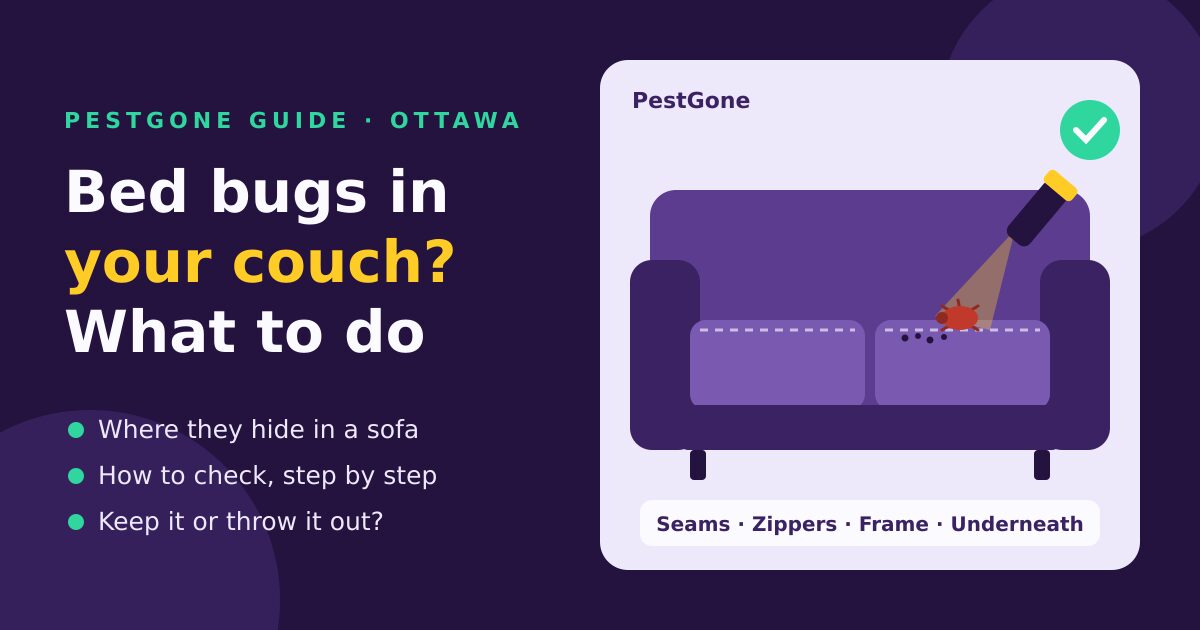
Bed bugs hide in the tightest, darkest parts of a couch, closest to where people sit: seams, zippers, the crevices between cushions and the frame, and underneath. The usual spots are:
- Seams, piping and welting along the edges of cushions and the arms.
- Inside cushion zippers and the corners of removable covers.
- Buttons, tufts and pleats on tufted sofas.
- The crevice where the seat cushions meet the back and arms.
- The fabric skirt and the gap where it meets the frame.
- Underneath: the thin dust cover stapled to the bottom, the staples themselves, and the joints of the wooden frame.
- Legs, especially screw-in legs with a gap at the top.
- Recliners: the folding footrest, the springs and the moving mechanism underneath, which have many joints and cracks.
- Sofa beds: the fold-out mattress and its metal frame, which need checking just like a bed.
- Leather and faux-leather couches: fewer fabric seams, but bed bugs still hide in stitching, under cushions and in the frame.
- Nearby: the baseboard and carpet edge behind the couch, side tables, and throw pillows and blankets.
How do I check my couch for bed bugs?
Check a couch for bed bugs with a bright flashlight and a thin, stiff card, working slowly from the seams to the frame. It takes about 20 minutes. Do it in daylight or with the room lights on:
- Take off all the cushions, throws and pillows and set them on a light-coloured sheet so anything that drops is easy to see.
- Run the edge of a card (an old gift card works) along every seam and piping on the cushions, and shine the light into the fold.
- Open the cushion zippers and look inside the corners of the covers.
- Look deep into the crevices where the seat meets the back and arms. A card or a flat tool helps lift the fabric.
- Tip the couch onto its back, if you can do it safely with help, and check the dust cover underneath, the staples and the frame joints.
- Check the legs, the baseboard behind the couch and any side tables.
- For a recliner or sofa bed, open it fully and check the mechanism or the fold-out mattress.
- If you find something, put clear tape over it or take a sharp photo. It makes identification easy for your technician.
Do not drag the couch into another room or out of the home to inspect it. If bed bugs are in it, that spreads them.
Why are there bed bugs in my couch but not my bed?
Bed bugs can end up in a couch and not a bed because the couch is where someone in the home rests the longest. They settle closest to their food source. The usual reasons are:
- Someone sleeps or naps on the couch, such as a night-shift worker, a guest, or someone who falls asleep watching TV.
- The couch came from somewhere else: a second-hand find, a curbside pickup, or furniture from a previous home or storage locker.
- Visitors or a trip: bed bugs can ride in on bags and coats that are put down on the couch.
- People moved to the couch after finding bites in bed. That is one of the most common ways bed bugs spread inside a home.
Even if you have only found them in the couch, check every bed in the home too. Finding them early in one piece of furniture is the easiest situation to treat.
What should I do if I find bed bugs in my couch?
If you find bed bugs in your couch, stop using it for sleep, leave it where it is, and book an inspection. Do not try to get rid of the couch in a rush. These steps keep the problem small until treatment:
- Keep sleeping in your own bed. Do not move from the couch to a bedroom or a friend's place, or the bugs may follow you there.
- Vacuum the seams and crevices with a crevice tool, then seal the vacuum contents in a plastic bag and take it straight to the outside garbage.
- Wash and dry throws, pillow covers and removable cushion covers. Ottawa Public Health advises drying on a hot setting for at least 30 minutes. Check the care label first; covers that cannot go in the dryer can be bagged and set aside for your technician.
- Bag washed items in sealed plastic bags and keep them in the same room until treatment.
- Reduce clutter around the couch, such as bags, piles of clothes and boxes, without carrying it to other rooms.
- Pull the couch a little away from the wall so it does not touch the wall or curtains.
- If you rent, tell your landlord or property manager in writing. In Ottawa, landlords are generally responsible for pest treatment, and tenants for preparing the unit. Our guide on bed bugs in an apartment covers that process.
What not to do with a couch that has bed bugs
- Do not sleep on the couch while you wait. Every night there keeps the bugs fed and active.
- Do not use bug bombs or foggers. They do not reach bugs inside seams and frames and can scatter them into other rooms.
- Do not use homemade sprays, rubbing alcohol or products not labelled for bed bugs on upholstery. They can damage fabric, some are a fire risk, and they rarely reach bugs hidden in the frame.
- Do not move the couch to another room, the garage or a storage locker. Bugs drop off along the way and the problem follows you.
- Do not put it out on the curb in a panic. Someone else may take it home, and the bugs left behind in your home stay put.
- Do not give it away or sell it. That passes the problem to someone else.
Should I throw out my couch if it has bed bugs?
Usually not. Most couches with bed bugs can be treated and kept, and throwing one out does not solve the problem, because bed bugs are almost always in the floor, baseboards and other furniture nearby as well. A new couch brought into an untreated room can be infested within weeks.
Throwing a couch out can make sense if it is torn, falling apart, or the infestation is very heavy and you were planning to replace it anyway. Wait until your technician has seen it, so it can be treated or wrapped first. If you do get rid of it, wrap it completely in plastic, mark it clearly as having bed bugs, and slash or damage the fabric so nobody takes it home. Health Canada advises never taking home a mattress or sofa left at the curb.
The same keep-or-replace question comes up for mattresses, and our guide on how long bed bug treatment takes covers that, along with what to expect after treatment.
How do I check a second-hand couch for bed bugs?
Check a second-hand couch before it comes inside, not after. Do it at the seller's place, in the driveway or in the garage, using the same flashlight-and-card check described above. Pay special attention to:
- The seams, piping and zippers on every cushion.
- The dust cover and staples underneath, and the wooden frame joints.
- The mechanism of a recliner and the fold-out mattress of a sofa bed.
- Dark spots, shed skins, eggs or live bugs anywhere on it.
Never take a couch or mattress left at the curb, even if it looks clean. Health Canada's advice on preventing bed bugs starts with checking second-hand furniture before it comes home, and moving season in Ottawa, when furniture changes hands across the city, is when this matters most.
How does professional bed bug treatment work on a couch?
Professional bed bug treatment treats the couch along with the rest of the home, because bed bugs rarely stay in one piece of furniture. Here is how it works:
- Inspect: we confirm it is bed bugs and check the couch, beds, frames, headboards, other furniture and baseboards to see how far they have spread.
- Prepare: you get a step-by-step preparation guide before the visit, including what to wash, what to bag and how to pull furniture away from the walls. Our bed bug preparation checklist shows what it involves.
- Treat: steam kills bed bugs and eggs on contact in the seams, tufts and frame of the couch, and a targeted spray reaches the cracks, frame joints and baseboards where bugs were hidden.
- Follow up: a second treatment about two weeks later catches bugs that hatch from eggs after the first visit.
Plan to be out of the treated rooms until the spray has dried, usually a few hours. Your technician tells you the exact time on the day. We treat homes across Ottawa, from apartments in Bayshore and Centrepointe in Nepean and condos in Westboro to houses in Bridlewood and Kanata Lakes in Kanata and Half Moon Bay in Barrhaven. A discreet visit is available on request.
Quick answers about bed bugs in couches
Can bed bugs live in a leather couch?
Yes, though less easily than in fabric. They hide in stitching, under cushions and in the frame rather than on the smooth leather itself.
Can bed bugs spread from the couch to my bed?
Yes. They follow people, so a couch infestation can reach bedrooms, especially if someone moves between rooms to sleep.
Will vacuuming get rid of bed bugs in my couch?
No. It removes some bugs and eggs and is worth doing, but it cannot reach bugs deep in the frame or kill the eggs it misses.
Do bed bugs bite during the day on a couch?
They mostly feed at night, but they will feed in the day if someone sits still or naps for a long time.
Can I keep using the couch during treatment?
For sitting, usually yes, once treated areas have dried and your technician says so. Do not sleep on it until the problem is gone.
How much does bed bug treatment cost in Ottawa?
Our bed bug treatment is one flat price of $399 plus HST for your home, including the follow-up treatment about two weeks later and a six-month guarantee: if bed bugs return, we re-treat for free. Couches and other furniture are covered by the same price. Whole buildings are quoted separately. You can compare all our services on the pricing page.
Book bed bug treatment online
Pick a day and time window on our booking page and we will email you to confirm. Bed bug treatment includes an inspection to confirm bed bugs before treating, steam and spray treatment of beds, frames, headboards, furniture, baseboards and cracks, a step-by-step preparation guide before the visit, a follow-up treatment about two weeks later, advice on mattress and box-spring encasements, a discreet visit on request, and a six-month guarantee: if bed bugs return, we re-treat for free.
Have a question first? Read our pest control FAQ or contact us.
Book online See bed bug treatment ($399 + HST)
Not sure what you're dealing with? Call 343-341-2815 and describe it. We'll tell you what it is and what it costs.
Keep reading
Sources
- Bedbugs: how do I prevent an infestation?, Health Canada
- Bedbugs: how do I get rid of them?, Health Canada
- Bed bugs, Ottawa Public Health
General information for homeowners. Every home is different; your technician will confirm what applies to yours.
Let's make them gone.