Signs of rats in the house, and how to tell rats from mice
Heavy thumping in the ceiling, droppings that look far too big for a mouse, or a hole dug beside the foundation: once Ottawa turns cold, rats look for the same warmth mice do. This guide covers the signs of rats in and around your house, how to tell rats from mice, what to do right now, and when it is time to call for help.
Book mouse & rat control online
How do I know if I have rats in my house?
The clearest signs of rats in the house are large droppings (about the size of a raisin or bigger), heavier scratching or thumping noises at night, gnaw holes bigger than a thumb, greasy rub marks along walls and pipes, and burrows dug into the soil beside the foundation, under a deck or under a shed. Rats are cautious and mostly active at night, so you are far more likely to find what they leave behind than to see one.
The difference between rats and mice matters: rats are bigger, stronger chewers and usually need more bait stations and more follow-up. Our mouse and rat control covers both, and telling your technician what you have found helps them plan the visit.
Rats or mice? How to tell the difference
Most homes in Ottawa that have rodents have mice, but rats do turn up, especially in older neighbourhoods, near ravines and creeks, and around homes with compost, bird feeders or easy garbage. These are the quickest ways to tell them apart:
- Size. A house mouse is small enough to fit in your palm. An adult rat is several times bigger, with a body roughly the length of your hand before you count the tail.
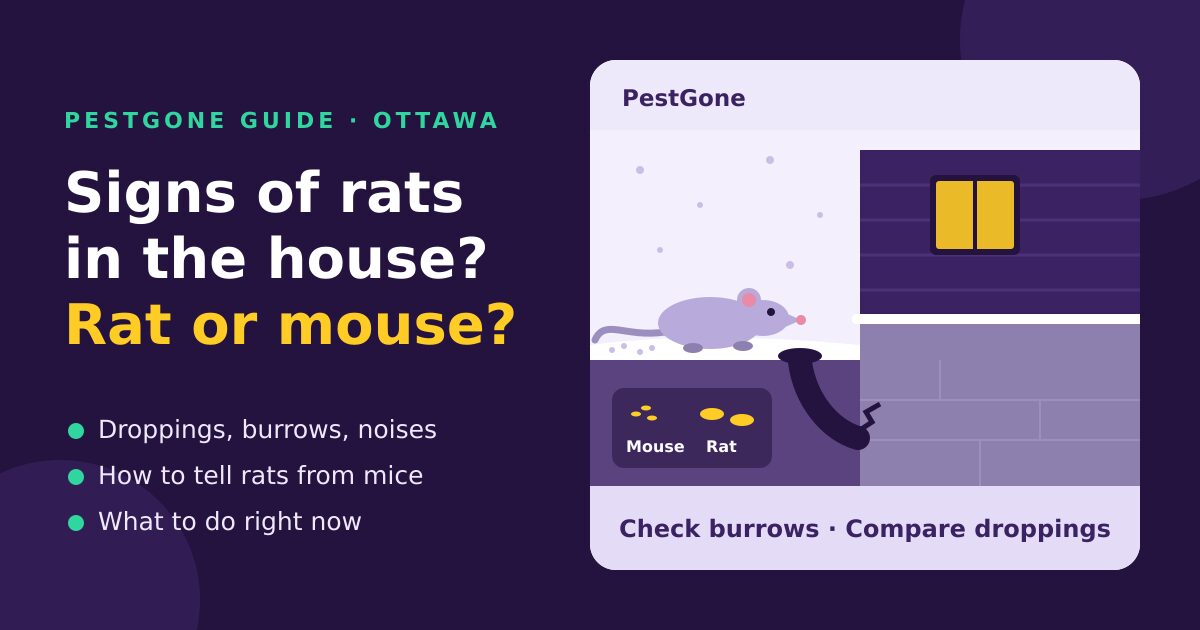
- Droppings. Mouse droppings look like grains of rice with pointed ends. Rat droppings are much larger, about the size of a raisin or bigger, and often blunter at the ends.
- Noise. Mice make light, quick scratching. Rats are heavier: thumping, gnawing you can clearly hear, and sometimes the sound of something being dragged.
- Gnaw holes. Mouse holes are small and neat. Rat holes are bigger, with rough, torn edges, and rats can chew through wood, soft plastic, rubber seals and even soft metal flashing.
- Burrows. Mice nest inside. Norway rats, the common rat in Ottawa, often dig burrows outside along foundations, under decks, slabs and sheds, and beside compost bins.
- Behaviour. Mice are curious and investigate new things quickly. Rats are wary of anything new in their path, which is one reason rat jobs often take longer and need more patience.
If what you are finding sounds more like mice, our guide to the signs of mice in your house goes through each mouse sign and where to look first.
Rat droppings vs mouse droppings
Droppings are the most reliable way to tell what you have. Rat droppings are dark, thick and roughly the size of a raisin or larger, usually found in smaller groups along a route the rats use often: beside a wall, behind stored items in the garage, near a food source or at the edge of a hole. Mouse droppings are much smaller, like a grain of rice, and tend to be scattered along baseboards and inside cupboards and drawers.
Fresh droppings of either kind are dark and soft. Older ones turn grey and crumble. If you are finding both small and large droppings, you may have both mice and rats, and it is worth mentioning that when you book.
Signs of rats outside your house
With rats, many of the clues are outside, so walk around the house in daylight. In winter, fresh snow makes this easier, because tracks and runways show up clearly. Look for:
- Burrow holes in the soil along the foundation, under the deck, under the shed or beside a compost bin. They are usually a few centimetres across, with smooth, packed edges and sometimes loose soil fanned out at the entrance.
- Runways: narrow, worn paths through grass, or packed trails in the snow, running along fences, walls and the edges of the yard between cover and food.
- Tracks in snow, mud or dust. Rat footprints are noticeably bigger than mouse prints, often with a tail-drag line between them.
- Chewed garbage, recycling or green bins, especially lids with a hole gnawed through the edge.
- Spilled birdseed under feeders that disappears overnight, or seed hulls and droppings under the deck.
- Gnawing on the outside of the house: chewed corners on wood trim, a garage-door seal with a ragged hole, or chewed vent covers.
Signs of rats inside: noises, smells, rub marks and damage
- Noises at night: heavy scurrying, thumping or gnawing in ceilings, walls and under floors, usually starting after dark. Our guide to scratching in the walls at night explains how to tell rodent noises from squirrels and other causes.
- Rub marks: dark, greasy smudges along the bottom of walls, around pipes, along beams and at the edges of holes. Rats use the same routes night after night, so the marks build up and are wider and darker than mouse marks.
- Gnawing damage to stored food, pet food bags, wooden doors and baseboards, plastic bins, pipes and wiring. Chewed wiring is a fire risk; if you see bare wire, have an electrician check it.
- A strong musty or ammonia smell in the basement, garage or a closed cupboard, from urine and nesting.
- Nests of shredded insulation, paper and fabric in quiet places such as the back of the basement, inside a crawl space, under the insulation or in stored boxes.
Why rats come inside in winter, and where they get in
Rats live outdoors much of the year in Ottawa, in burrows, sheds, woodpiles and under decks. When the ground freezes and outdoor food gets scarce, they move closer to warmth and food. Heated basements, garages and crawl spaces are ideal, and a house with a bird feeder, open compost, pet food in the garage or a garbage area that is easy to get into gives them a reason to stay.
Rats also need water every day, so damp basements, leaky pipes and sump pits make a home more attractive. And because rats breed through much of the year when they have shelter and food, a problem that starts in November can be much bigger by spring if nothing is done.
Health Canada notes that a rat can squeeze through a hole about the size of a quarter, and a mouse through a gap about the width of a dime. Rats are also strong diggers and chewers, so they widen gaps that start out too small. The most common ways in are:
- Gaps around pipes, cables, gas lines and air-conditioning lines where they pass through the wall.
- Cracked or crumbling foundations, and the gap where the wood framing sits on top of the foundation wall. Older stone and block foundations in areas like Westboro and older parts of Alta Vista often have more of these gaps.
- Worn or chewed garage-door seals, and gaps around the side door of the garage. See mice in the garage in winter, because the same routes work for rats.
- Burrows under decks, porches, slabs and additions that lead to a gap in the foundation or crawl space.
- In some older homes, an open or broken floor drain or a damaged sewer connection. If you see signs right around a floor drain, mention it to your technician and, where needed, a plumber.
Our guide on how mice get in and how to keep them out covers the materials that hold up against chewing, and most of it applies to rats too.
What to do right now if you think you have rats
You can do a lot today to make your home less inviting and to help your technician find the problem quickly:
- Take down bird feeders for now and clean up spilled seed under them.
- Move pet food, birdseed and grass seed into sealed metal or hard plastic containers, inside and in the garage.
- Keep garbage, recycling and green bins closed tight, and store them away from the side of the house if you can.
- Do not leave pet food or water bowls out overnight.
- Fix dripping taps and leaks, and keep the sump pit covered.
- Move firewood, lumber and clutter away from the house and off the ground, and clear stored boxes off the basement and garage floors so you can see new droppings.
- Write down where and when you hear noises or find droppings. That pattern helps your technician place bait stations where rats actually travel.
What not to do
- Do not put out loose poison yourself. Rats can drag it into walls or out into the yard where pets, children and wildlife can reach it, and a rat that dies inside a wall can leave a smell that lasts for weeks. Any product sold for rodents in Canada should carry a Pest Control Products (PCP) number.
- Do not seal holes while rats are still inside. Trapped rats chew new holes, often in a worse place. Treat first, then seal.
- Do not rely on spray foam, caulk, wood or plastic to block a rat hole. Rats chew through all of them. Holes need metal mesh, metal flashing or concrete.
- Do not corner or try to catch a rat. A cornered rat can bite. Leave a door open to the outside and let it go, or leave the room and close the door.
- Avoid glue traps. They are inhumane and can catch pets and wildlife. We do not use them, or snap traps, on our jobs.
- Do not ignore it until spring. Rats do not leave a warm house with food on their own, and numbers can grow over the winter.
Are rats dangerous? How to clean up safely
Rats can carry germs in their droppings and urine, and they can contaminate food and surfaces. Their chewing can damage wiring, insulation, pipes and stored belongings. Bites are uncommon, but if anyone is bitten or scratched, wash the area well with soap and water and see a doctor.
The Public Health Agency of Canada's advice for cleaning up after rodents is the same for rats and mice:
- Air out closed spaces like garages, sheds and crawl spaces for a while before you start.
- Wear rubber or disposable gloves, and a mask if you are cleaning up a large amount in an enclosed space.
- Do not sweep or vacuum droppings dry, because it puts particles into the air.
- Spray droppings, urine spots and nesting material with a household disinfectant, or 1 part bleach to 9 parts water, and let it soak for about 10 minutes.
- Wipe it up with paper towels, double-bag everything, and put it in the outside garbage.
- Disinfect the area again, then wash your gloved hands, take the gloves off and wash your hands with soap and water.
How to keep rats away for good
Treatment deals with the rats that are there now. Keeping new ones out comes down to taking away food and shelter and closing the gaps. Our winter mouse-proofing checklist walks the house from the outside in, and these steps matter most for rats:
- Keep garbage, compost and green bins closed, and choose a compost bin with a solid base or a fine metal mesh underneath.
- Feed birds only from feeders with a seed tray, and keep the ground under them clean, or stop feeding over the winter.
- Keep a clear gap between the house and woodpiles, shrubs and stored items.
- Block the space under decks and sheds with buried metal mesh, so rats cannot burrow underneath.
- Seal gaps around pipes and cables with steel mesh packed in tightly and sealant over it, and cover larger openings with metal.
- Replace worn garage-door seals and door sweeps.
For bigger gaps at the foundation, roofline, vents and garage, our rodent proofing service seals entry points with materials rats cannot chew through. You get photos of every gap and a written price before any work starts. If rodents have come back after an earlier treatment, read do mice come back after extermination: the same reasons apply to rats.
When to call a professional for rats
Call as soon as you are fairly sure it is rats rather than mice. Rats are cautious around anything new and need more bait stations in the right spots, and their burrows and entry points are often outside where you would not think to look. Book a visit if you find large droppings, burrows beside the house, gnaw holes bigger than a thumb, chewed wiring, or noises most nights.
In semi-detached homes and townhouses, which are common in Barrhaven, Orléans and across the suburbs, rodents can travel along shared walls and between yards, so let your neighbours know. If you rent, tell your landlord or property manager in writing before you book, because pest control in a rental unit is generally the landlord's responsibility in Ottawa.
How much does rat control cost in Ottawa?
Our mouse and rat control is one flat price of $299 plus HST for houses, townhomes and condos, including the follow-up visit and a six-month guarantee. Rats can need more bait stations and more follow-up than mice, so if the inspection shows the job is larger than a standard treatment, we confirm the price with you before doing any extra work. Sealing the entry points is a separate rodent proofing service, quoted in writing after an inspection. Every price is on our pricing page.
Quick answers about rats in the house
Can you have rats and mice at the same time?
Yes. If you are finding both small rice-sized droppings and much larger ones, tell us when you book. Our service covers both.
Will rats leave on their own?
Rarely. A warm house with food and water is a good place to spend the winter, and rats breed when they have shelter.
Are bait stations safe with kids and pets?
We use tamper-resistant, locked stations placed where children and pets cannot reach them, and we tell you where every station is.
Do I need to leave the house during treatment?
No. The stations are sealed and tamper-resistant, so you can stay home during the visit.
How long does it take to get rid of rats?
Rats are cautious, so it can take longer than with mice. The follow-up visit is when we check activity and adjust the stations.
Book rat and mouse control online
Pick a day and time window on our booking page and we will email you to confirm. Mouse and rat control includes a full inspection of the basement, attic access, garage and exterior, tamper-resistant locked bait stations placed away from children and pets (we do not use snap traps or glue traps), a photo report of the entry points we find, small gaps sealed with steel mesh on the first visit, a follow-up visit to check activity and adjust the stations, and a six-month guarantee: if mice or rats return, we re-treat for free.
Not sure whether it is rats or mice? Book anyway and tell us what you have found in the notes; the inspection will confirm it. You can also read our pest control FAQ or contact us first.
Book online See mouse & rat control ($299 + HST)
Keep reading
Sources
- Rats and mice, Health Canada
- Hantavirus: spread, prevention and risks, Public Health Agency of Canada
General information for homeowners. Every home is different; your technician will confirm what applies to yours.
Let's make them gone.