Do mice come back after extermination?
You had the mice treated, things went quiet, and now you have found fresh droppings or heard scratching again. Here is why mice come back after extermination, how to tell a real return from leftover signs, and what actually keeps them out of an Ottawa home.
Book mouse & rat control online
Do mice come back after extermination?
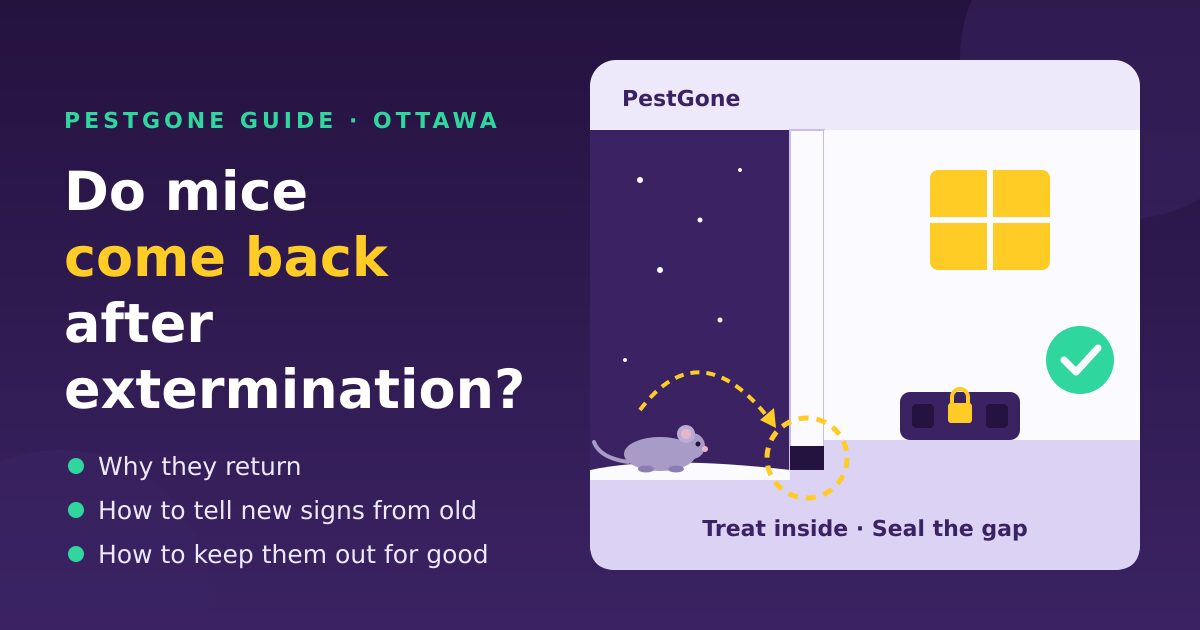
They can. Treatment deals with the mice that are living in your home now. It does not stop new mice from finding the same way in. If the gaps they used are still open, and there is still food and shelter inside, the next mice that come along can move into the space the last ones left.
That is why a good mouse treatment has two parts: reducing the mice that are inside, and finding and closing the entry points they use. Homes where both parts are done are far less likely to see mice again. Homes where only the first part is done often see them return the next time the weather turns cold.
Seeing a sign of mice after treatment does not always mean they are back, either. Old droppings, a mouse that took a few days to reach the bait, or noise from a different animal can all look like a return. The sections below explain how to tell the difference, and what to do in each case. If you are not sure you had mice in the first place, start with our guide to the signs of mice in your house.
Why do mice keep coming back?
When mice return after an exterminator has been, it is almost always for one of these reasons:
- The entry points were never sealed. A mouse can squeeze through a gap about the width of a pencil, and most homes have several: around pipes and cables, under the garage door, at the top of the foundation wall and around vents.
- Only some of the gaps were sealed. Mice that lose one route will find another if there is a second gap nearby, often one higher up or behind a deck or stairs.
- Food is still easy to reach. Birdseed, pet food, grass seed, pantry goods in bags and boxes, and crumbs behind the stove all keep a home attractive to mice.
- Nesting material is close at hand. Cardboard boxes, stored fabric, insulation and clutter in the basement or garage give new mice a ready place to settle.
- Bait stations were moved, emptied or removed too early, so the last few mice were not reached.
- Mice live next door. In semis, townhouses and condo buildings, mice can travel through shared walls, ceilings and utility runs, so a unit next to an untreated one can see them again.
- The season changed. Mice look for warmth when the nights get cold, so a home that was quiet in summer can see new mice arrive in the fall, even if it was treated in spring.
Is it the same mice or new ones?
Usually it is new mice using the same route. Mice follow scent trails and the oils from their fur leave faint marks along walls and pipes, so a gap that was used once is easy for the next mouse to find. That is why droppings often turn up in exactly the same place after a quiet spell.
Sometimes it is a mouse that was there all along. A mouse nesting in a wall or under a floor may take longer to reach a bait station than the others, or may be travelling in from the garage or a crawl space. That kind of activity usually shows up within the first couple of weeks after treatment, and it is what the follow-up visit is for.
If the signs come back months later, especially in the fall, you are almost certainly dealing with new mice, and the answer is to find and close the gap they are using.
How long after extermination should mice be gone?
The bait in our stations works over several days, so most homes see activity drop within a week or two. You may still hear a little movement or find a few fresh droppings in the first days after the visit. That is normal: mice have to find the stations and feed from them before they are affected.
Our mouse and rat control includes a follow-up visit to check activity and top up or adjust the stations. If mice are still feeding by then, the technician moves stations to where the activity is, or adds them where needed. Do not judge the result the morning after the first visit. Judge it after the follow-up.
If you are still hearing noise in the walls after a couple of weeks, our guide to scratching in the walls at night explains how to tell mice from squirrels, pipes and other sounds.
Signs mice are back, and signs that are just left over
Not every dropping you find after treatment is new. The easiest way to tell is to clean up all the old signs once the treatment is done, so anything that appears afterwards stands out. Then look for:
- Fresh droppings: dark, soft and slightly shiny. Old droppings are dry, dull, greyish and crumble when pressed. Wear gloves and do not touch them with bare hands.
- Droppings in a spot you have already cleaned. This is the clearest sign of new activity.
- Newly chewed food packaging, or fresh gnaw marks with pale, clean edges.
- New nesting material: shredded paper, fabric or insulation in a box or corner that was clear before.
- Scratching that comes back night after night, rather than a single sound.
- Small tracks in dust on basement shelves or on the garage floor, or in fresh snow near the corners of the garage door.
A useful trick: once you have cleaned up, lay a light dusting of flour or a sheet of paper along a wall where you used to find droppings, away from children and pets. Small footprints the next morning tell you mice are travelling there.
Why mice come back every winter in Ottawa houses, semis and condos
Ottawa's long, cold winters are the main reason mice are a repeat problem here. As the nights drop below freezing in the fall, mice that spent the summer outdoors look for warm, dry places with food nearby, and a house, garage or shed is ideal. A home that was treated in March and went quiet all summer can see new mice arrive in October or November if the gaps are still open.
The type of home matters too. Newer subdivisions beside fields, construction sites and the greenbelt, such as parts of Kanata, Barrhaven and Stittsville, can see mice moving in as the land around them changes. Older homes in neighbourhoods like Westboro often have more gaps in stone or block foundations, around old service lines and where additions meet the original house.
Attached garages are another common way back in. If you are finding signs near the garage, our guide to mice in the garage in winter walks through how mice get from the garage into the house.
Shared walls change the picture. In a semi-detached house, a row of townhouses or a condo building, mice can move between homes through wall cavities, ceiling spaces and the openings where pipes and cables run between units. If one home is treated and the next one is not, mice can keep arriving from next door.
If you share walls, it helps to talk to your neighbours, or to your condo board or property manager, so that the problem can be dealt with in more than one unit. If you rent, tell your landlord or property manager before you book: in Ottawa, treating pests in a rental unit is generally the landlord's responsibility.
What to do if mice come back after the exterminator
If you are seeing fresh signs, here is what to do, in order:
- Check whether it is new activity. Clean up the old droppings safely, then look again over the next few days.
- Leave the bait stations where they are. They are placed where mice travel, and moving them can make them less effective.
- Note where and when you see signs. A short list of spots and times helps the technician find the route the mice are using.
- Put food out of reach: pantry goods, pet food and birdseed in hard containers with lids, and crumbs cleaned up behind the stove and fridge.
- Clear cardboard and clutter from the basement and garage floor so new nests are easy to spot.
- Look for daylight under exterior doors and at the corners of the garage door, and check where pipes and cables go through the walls.
- Contact the company that did the treatment. If you are within a guarantee period, re-treatment is usually covered.
What not to do when mice come back
- Do not open, move or remove bait stations. They are locked for safety, and they need to stay where the technician placed them.
- Do not add your own poison. Store-bought bait placed in the open is a risk to children and pets, and mice can carry it into walls and die out of reach, leaving a smell that can last for weeks.
- Do not seal the house while mice are still inside. Sealing traps them in the walls, where they chew new holes or die out of reach.
- Do not plug holes with spray foam, caulk, newspaper or wood on their own. Mice chew straight through them.
- Do not sweep or vacuum droppings dry. Wet them with disinfectant first, then wipe them up, so dust does not spread.
- Do not wait until spring and hope they leave. Mice breed quickly indoors, and a few mice in November can become a bigger problem by February.
How to keep mice from coming back for good
Keeping mice out long term comes down to closing the gaps and making the home less inviting. Our winter mouse-proofing checklist walks through the whole house from the outside in, and our guide on how mice get in and how to keep them out explains the most common entry points. The main steps:
- Seal small gaps around pipes, cables and dryer vents with copper or steel mesh packed in tightly, then sealant over it.
- Cover larger openings with metal mesh (hardware cloth) or sheet metal, fastened down.
- Replace worn door sweeps, and the bottom seal on the garage door, including the corners.
- Move firewood a few metres from the house and keep it off the ground. Trim shrubs back from the siding.
- Store birdseed, grass seed and pet food in sealed metal or hard plastic bins, and keep garbage and green bins closed tight.
- Swap cardboard storage boxes for plastic tubs with lids.
- Fix leaks under sinks and around the water heater. Mice need water as well as food.
Many gaps are easy to reach. Others are high on the roofline, behind decks, under porches or where the siding meets the foundation, and are hard to see or reach safely. That is where rodent proofing helps.
Mouse control or rodent proofing: which do you need?
They do different jobs. Mouse control deals with the mice inside your home now: an inspection, locked bait stations, small gaps sealed on the first visit, a follow-up visit, and a photo report of the entry points we find. Rodent proofing deals with the next mice: it seals the gaps that let them in, with materials they cannot chew through.
If you have mice now, start with mouse control. If mice come back every fall, or the photo report shows gaps that are larger, higher or harder to reach than you can fix yourself, our rodent proofing service seals them with steel mesh, metal flashing and sealant, and fits door sweeps and garage-door seals. It starts with a full inspection, and you get photos of each gap and a written price before any work starts.
Does the guarantee cover mice coming back?
Yes. Our mouse and rat control carries a six-month guarantee: if mice or rats return to the treated property within six months of your final visit, we re-treat at no charge. The guarantee covers re-treatment, and it depends on following the preparation and sealing advice we give you, because open gaps and easy food are the main reasons mice return.
If you think the mice are back, tell us where and when you have seen signs, and we will arrange a visit. You can read more about how our guarantees work in our pest control FAQ.
Quick answers about mice coming back
- Is it normal to see mice after the exterminator comes? For a few days, yes. The bait works over several days, and most homes see activity drop within a week or two.
- How do I know if the mice are gone? No fresh droppings in spots you have cleaned, no new chewing and no scratching at night for a couple of weeks after the follow-up visit.
- Why do mice come back every fall? Cold weather pushes mice to look for warmth, and any gap left open gives them a way in.
- Can mice come back through the same hole? Yes. Mice follow scent trails, so an open entry point is easy for the next mouse to find.
- Do I need to leave the house during treatment? No. The stations are sealed and tamper-resistant, so you can stay home during the visit.
- Is it mice or rats? Rat droppings are much larger, about the size of a raisin, and rats make heavier noise. Our service covers both.
How much does mouse control cost in Ottawa?
Our mouse and rat control is one flat price of $299 plus HST for houses, townhomes and condos, including the follow-up visit and the six-month guarantee. Rats can need more stations and more follow-up, so if the job turns out larger than a standard treatment, we confirm the price with you after the inspection. Rodent proofing is quoted after an inspection, with a written price before any work starts. You can see every price on our pricing page.
Book mouse control online
If mice have come back, or you want them gone this winter, pick a day and time window on our booking page and we will email you to confirm. Mouse and rat control includes a full inspection of the basement, attic access, garage and exterior, tamper-resistant locked bait stations placed away from children and pets (we do not use snap traps or glue traps), small gaps sealed with steel mesh on the first visit, a photo report of the entry points we find, a follow-up visit to check activity and adjust the stations, and a six-month guarantee: if mice or rats return, we re-treat for free.
Want to ask something first? Contact us, or go straight to book mouse control online.
Book online See mouse & rat control ($299 + HST)
Keep reading
General information for homeowners. Every home is different; your technician will confirm what applies to yours.
Let's make them gone.