Are mouse bait stations safe for pets and kids?
Updated .
You want the mice gone, but you also have a toddler who opens every cupboard, a dog who eats anything on the floor, or a cat who hunts. That worry stops a lot of Ottawa families from booking mouse control. This guide explains how locked bait stations work, what the rules require, where the real risks are, and how to keep children and pets safe while the mice are dealt with.
Book mouse & rat control online
Are mouse bait stations safe for pets and kids?
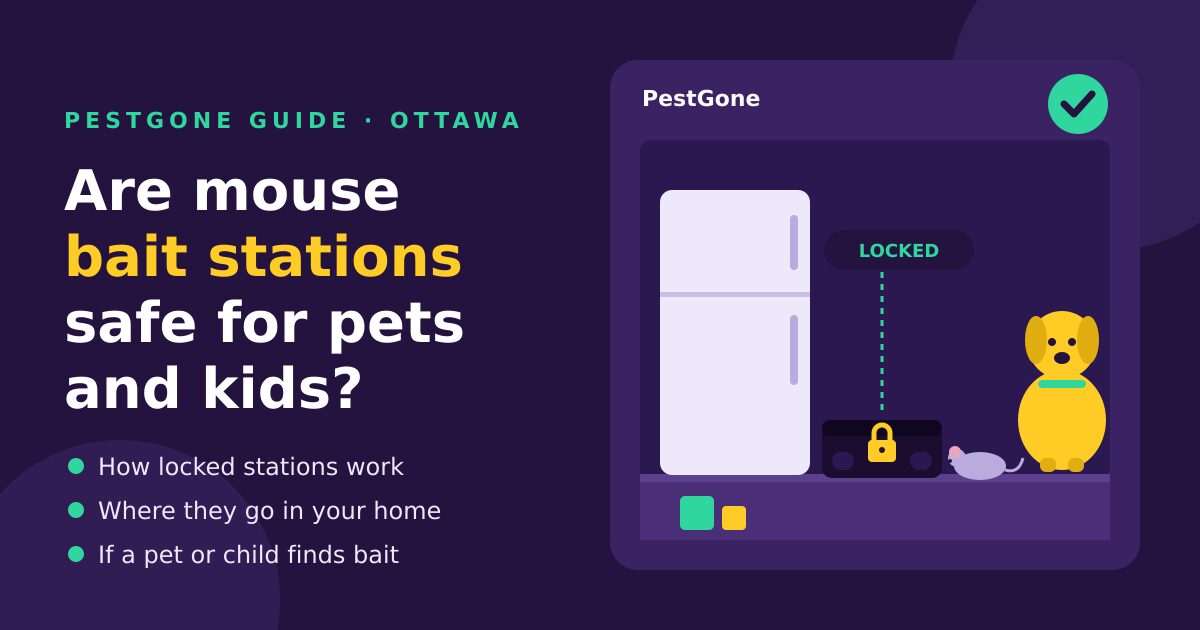
Locked, tamper-resistant bait stations are the safest way to use mouse bait in a home with children and pets. The bait is held inside a hard, locked box with an entrance only a mouse can use, and stations go where mice travel, out of reach. The real risks come from loose bait, stations left open, and pets eating poisoned mice.
So the honest answer is: a well-made station, placed and checked by a trained technician, keeps the bait away from little hands and paws. It does not make the bait itself harmless, which is why placement, locking and a few household rules matter as much as the box. The rest of this guide covers each of those.
What is a tamper-resistant bait station?
A tamper-resistant bait station is a sturdy plastic or metal box that holds rodent bait inside. Mice walk in through small entrance holes, feed, and leave. People and pets cannot reach the bait because it is fixed inside, away from the openings, and the lid locks with a key or tool.
Health Canada sets out what these stations must do for commercial rodenticides, the professional products only licensed operators and other authorized users may apply. Its requirements include:
- An inside design that stops the bait being shaken out of the box.
- An access panel that closes securely and locks.
- A label showing the product name, the active ingredient, the registration number, "WARNING - POISON" and a skull-and-crossbones symbol.
- Regular inspection by the user, and replacement of any station that is damaged.
That label matters to you as a parent or pet owner: if anything ever goes wrong, it tells a doctor, pharmacist or vet exactly what the product is.
How do locked bait stations keep children and pets out?
Locked stations keep children and pets out in three ways: a strong body they cannot break, a locked lid they cannot open, and an entrance designed so fingers, paws and snouts cannot reach the bait. Health Canada's requirements get stricter depending on who could reach the station:
- Indoors, where children could reach it: the station must be made of strong material that resists being broken by children, with an entrance that keeps children from reaching the bait.
- Indoors, where children and pets could reach it: the same, plus resistance to damage by animals, and an entrance pets cannot reach the bait through.
- Outdoors, above ground: all of the above, plus resistance to snow, rain, heat, cold and sunlight. Bait placed outside above ground, where children, pets or wildlife can reach it, must be in a tamper-resistant station.
Even so, a tamper-resistant station is not a toy-proof safe. A determined dog can chew a station or carry it off, and a station that was not locked properly offers little protection. That is why placement, and a technician who checks the stations on the follow-up visit, are part of keeping a home safe.
Where do bait stations go in a home with kids and pets?
Stations go where mice travel but your family does not: along walls and in tight, hidden spots that mice use and children and pets rarely reach. Mice keep close to walls and stay out of open floor, which makes it possible to put stations exactly where they are needed and nowhere else. Common places in an Ottawa house are:
- Behind the fridge, stove and dishwasher, along the path mice use to reach the kitchen. Our guide to mice in kitchen cabinets shows those routes.
- In the furnace or utility room, where pipes and lines come through the foundation wall.
- Along the top of the basement foundation wall, behind storage shelves, and in unfinished basement areas the kids do not play in.
- In the garage, along the wall shared with the house, away from where pets are kept.
- In attic spaces and crawl spaces, where activity is found.
Stations do not go inside kitchen cupboards next to food, in toy rooms, beside pet beds or water bowls, or in the middle of a floor. If a spot is the only good place for a station but a child or pet could get to it, your technician will look for another spot or talk through the options with you. You will be told where every station is, so you can keep an eye on them.
Can my dog or cat be poisoned by eating a poisoned mouse?
Yes, it can happen, and it is the risk most pet owners do not think about. Health Canada calls it secondary poisoning: a pet eats a mouse that has eaten bait, and swallows some of the poison too. Cats that hunt, and dogs that pick up dead animals, are the ones most at risk.
A mouse that has eaten bait does not die straight away, so it can still be moving around the house, the garage or the yard for a while. Ways to lower the risk:
- Keep cats that hunt out of the basement, garage or crawl space where stations are, during treatment if you can.
- Walk dogs on a leash around the yard and the side of the house for a few weeks, and do not let them pick things up.
- Check the garage, basement and under decks for dead mice every day or two while treatment is working. Pick them up with gloves or a plastic bag turned inside out, seal them in a bag and put them in the garbage.
- Tell your technician you have a hunting cat or a dog that scavenges. Health Canada advises asking a pest control professional about bait with lower potential for secondary poisoning, and your technician can explain the options for your home.
- Sealing the gaps mice use, so fewer mice come and go, cuts the risk down further. See our guide on how mice get into the house.
Are bait stations safer than poison pellets and store-bought products?
Yes. Loose bait, such as pellets, blocks or packets dropped behind appliances or into a wall, is where most accidents start. It can be pushed out by mice, dragged into the open, found by a crawling baby, or sniffed out by a dog. Health Canada notes that baits often contain food ingredients that attract pets.
Mice also carry bits of loose bait away and stash them, sometimes in places you would never think to check. Inside a locked station, the bait stays where it was put.
- Never put loose poison in cupboards, drawers, closets or anywhere children and pets can reach.
- If you buy a product yourself, buy only one registered with Health Canada. It will have a Pest Control Products (PCP) number on the label. Follow the label exactly, and store it in its original container, out of sight and reach.
- Do not move bait from one station or container to another, and do not break blocks into smaller pieces.
Are snap traps or glue traps safer than bait stations?
Not necessarily. Traps have no poison, which is why many parents look at them first, but they come with their own risks in a busy home. Snap traps can hurt small fingers and pets' paws and noses. Glue traps catch pets, birds and other animals, and they are cruel to the mice they catch. We do not use snap traps or glue traps on our jobs.
Traps can still be a reasonable choice for one mouse in a small space where nobody else can reach. But with several mice, or signs in more than one room, traps alone rarely keep up. If you are not sure how big the problem is, our guide to the signs of mice in the house helps you judge it.
What should I do if my child or pet gets into mouse bait?
Act right away and do not wait for symptoms. Some rodent baits take days to show signs, so the time to call is as soon as you think it happened.
- If a child may have eaten bait: call the Ontario Poison Centre or 911 right away, or go to a hospital. Do not try to make the child vomit unless you are told to.
- If a pet may have eaten bait, or a poisoned mouse: call your vet or an emergency vet clinic right away. Health Canada advises having the product name, how much may have been eaten, your pet's symptoms, and the time it happened.
- Take the label, a photo of the station label, or the product container with you. If your technician placed the stations, the product details are on the station, and you can contact us for them.
- Keep everyone away from the station or the spilled bait until it can be checked, then contact us so we can inspect, replace or move it.
House rules while bait stations are in place
A few simple rules keep everyone safe while the treatment works:
- Do not open, move or shake the stations. If one is in your way, tell us and we will move it.
- Check the stations now and then. If one is damaged, open, or has been moved, keep children and pets away and let us know.
- Tell babysitters, grandparents, dog walkers and cleaners where the stations are.
- Keep pet food, birdseed and garbage sealed, so mice go to the stations instead of your pantry.
- Do not add your own poison or traps beside our stations. It makes the treatment harder to read and adds risk.
- Keep the follow-up visit. It is when the technician checks activity, tops up or adjusts the stations, and removes any that are no longer needed.
Will mice die in the walls after eating bait?
It can happen, but good placement makes it much less likely. Mice that eat bait often head back to their nest, and some nests are in walls, ceilings or under floors. Placing stations along the routes mice use, and not sealing the last gaps until activity has stopped, gives them less reason to die somewhere you cannot reach.
If you notice a smell, or new signs such as fresh droppings after treatment, tell us. Our guide on whether mice come back after extermination explains how to tell old signs from new ones.
Mouse control in Ottawa homes with young children and pets
Many of the homes we treat have young children, dogs or cats. In the newer family subdivisions of Kanata, Barrhaven and Orléans, mice often arrive from fields, ravines and building sites in the fall, and the garage and basement are where stations usually go. In older homes in Westboro, the Glebe or Vanier, mice tend to use gaps in old foundations, and stations go in basements and utility rooms that children and pets can be kept out of.
In condos and apartments, there is less space to work with, so stations go behind and under appliances and in utility closets. If you saw your first mouse only recently, start with our guide on what to do if you saw a mouse in the house, then book before the mice settle in for winter.
Quick answers about bait station safety
Do I need to leave the house when bait stations are placed?
No. The stations are sealed and tamper-resistant, so you, your children and your pets can stay home during the visit.
Can a dog open a locked bait station?
Stations are built to resist animals, but a determined dog can chew or carry one off. Stations go where dogs cannot reach, and you should tell us if one has been disturbed.
Is bait safe around a crawling baby?
Bait inside a locked station placed behind appliances or in a closed-off area is out of reach. Loose bait never is, so it should never be used in a home with a baby.
Can my cat get sick from catching a mouse?
Yes, if the mouse has eaten bait. Keep hunting cats away from treated areas while the treatment works, and tell your technician about them.
How long do bait stations stay in my home?
Until activity has stopped. Your technician checks them on the follow-up visit and adjusts or removes them.
Are there pet-safe mouse baits?
No rodent bait is harmless to pets if they eat enough of it. Safety comes from locked stations, careful placement and keeping pets away from poisoned mice.
How much does mouse control cost in Ottawa?
Our mouse and rat control is one flat price of $299 plus HST for houses, townhomes and condos, including the follow-up visit and our six-month guarantee. Sealing entry points is a separate rodent proofing service, quoted in writing after an inspection. See every price on our pricing page.
Book mouse control online
Pick a day and time window on our booking page and add a note about children and pets, so your technician can plan where the stations go. Mouse and rat control includes a full inspection of the basement, attic access, garage and exterior, tamper-resistant locked bait stations placed away from children and pets (we do not use snap traps or glue traps), a photo report of the entry points we find, small gaps sealed with steel mesh on the first visit, a follow-up visit to check activity and adjust the stations, and a six-month guarantee: if mice or rats return, we re-treat for free.
Have a question first? Read our pest control FAQ or see what's included in mouse control in Ottawa.
Book online See mouse & rat control ($299 + HST)
Not sure what you're dealing with? Call 343-341-2815 and describe it. We'll tell you what it is and what it costs.
Keep reading
Sources
- Commercial class rodenticides: tamper-resistant bait stations requirements, Health Canada
- Keep your pets safe when using pesticides, Health Canada
General information for homeowners. Every home is different; your technician will confirm what applies to yours.
Let's make them gone.